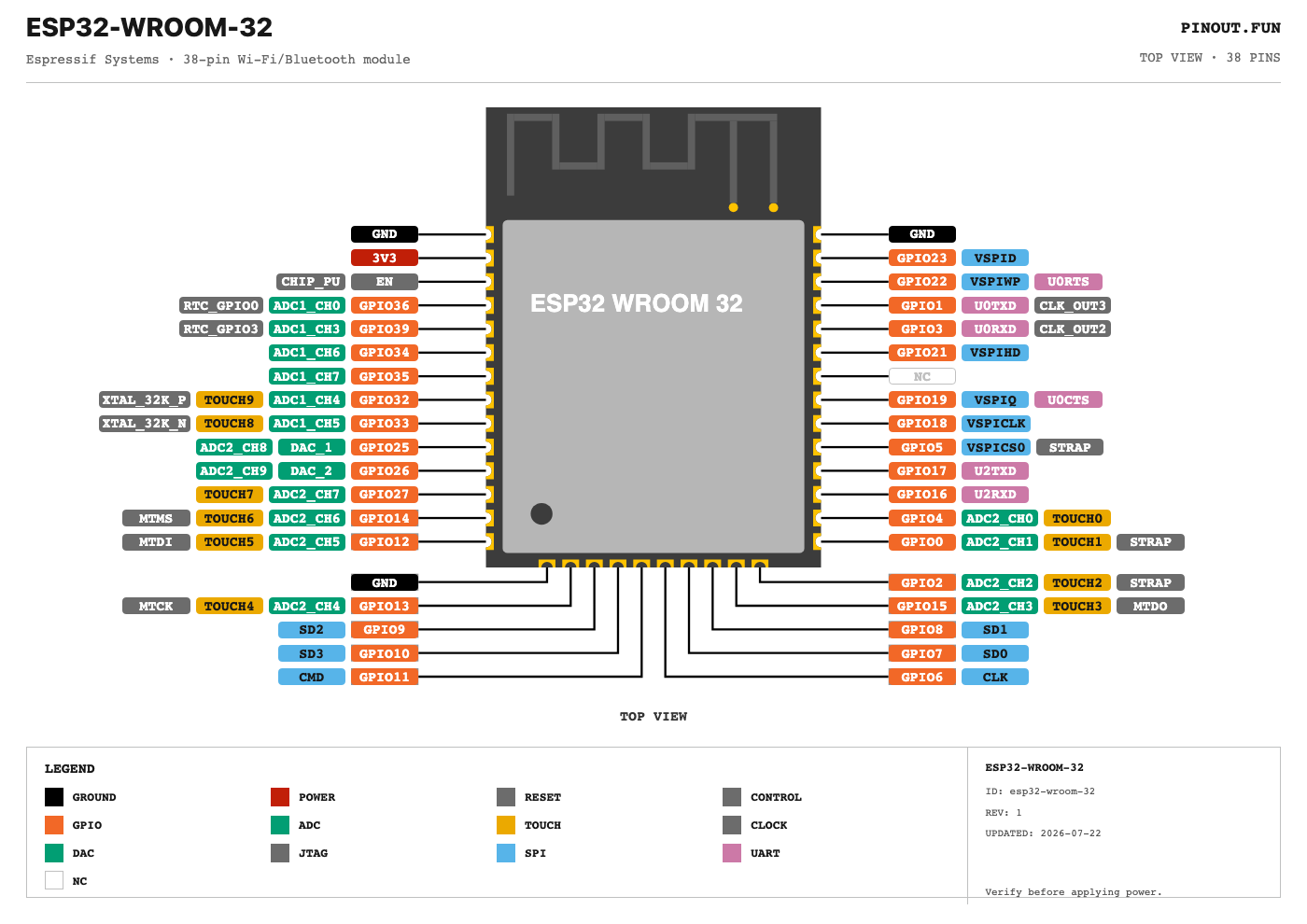
Silicon platform
ESP32 platform
The classic ESP32 platform combines a dual-core MCU, 2.4 GHz Wi-Fi, and Bluetooth 4.2 for connected control, audio, and general IoT devices. Modules further fix the flash, antenna, and available pins.
Module implementation
Dual-core Wi-Fi and Bluetooth MCU module widely used in IoT applications.
Espressif Systems · 38-pin Wi-Fi/Bluetooth module
- Processor
- Dual-core Xtensa LX6 · up to 240 MHz
- On-chip memory
- 520 KB SRAM · 448 KB ROM
- Wireless
- 2.4 GHz Wi-Fi 4 · Bluetooth 4.2
- Analog
- 18-channel ADC · 2 DACs · 10 touch channels
Chip capabilities
Flexible GPIO Matrix
Most digital peripheral signals can be routed through the GPIO Matrix. This page labels only fixed IO_MUX functions stated by the datasheet, not arbitrary routable defaults.
Rich digital peripherals
The chip provides SPI, UART, I2C, I2S, SD/SDIO, TWAI, and an Ethernet MAC; usable pins depend on module reservations and project configuration.
Analog and low-power functions
Dual SAR ADCs, two DACs, touch sensing, and RTC GPIO support acquisition, waveform output, and deep-sleep wake-up.
Dual-mode Bluetooth
Bluetooth Classic BR/EDR and Bluetooth Low Energy support legacy serial or audio profiles as well as low-power links.
Module features
- ESP32-D0WDQ6 dual-core MCU, 40 MHz crystal, 4 MB SPI flash, and PCB antenna integrated in one module
- UART0 on GPIO1/GPIO3 is the documented firmware-download and log interface
- GPIO25/GPIO26 provide the two fixed 8-bit DAC outputs
- Castellated edge pads support direct surface mounting
Downloads